

Sources of nitrogen compounds in new reservoirs.
The first few days of operation are a challenging time for any aquarist. A newly set-up aquarium is initially a source of joy and pride, but after a few days, it often turns into a nightmare when uninvited guests – algae – appear. The main cause of these problems is the lack or small number of beneficial bacteria colonies. The accumulation of nitrogen compounds (primarily ammonium), organic carbon, and phosphates, combined with strong lighting, provide an excellent breeding ground for all kinds of protozoan algae and diatoms (if silicates are also present in the water). Nitrogen sources in a newly set-up aquarium include substrates such as garden soil, substrates or Japanese-type "soil," plants (e.g., decaying leaves and stems), leftover in vitro nutrient solutions, and roots used for the setup. Nitrogen in substrates most often occurs in the form of ammonium (NH4 + ) , nitrate (NO3 ) , and nitrite ( NO2 ) , while small amounts may also be present as urea or its derivatives. Damaged or degrading plants release proteins and amino acids into the water, which are converted mainly into ammonium ions as a result of ammonification[1].
The importance of oxygen in nitrification processes
Nitrification is a two-step process and can be represented by simplified reactions[2]:
Stage I: NH4+ + 2O2 →NO2– + 2H2O
Stage II: NO2– + 1/2O2 → NO3–
In each of the two stages, the necessary substrate is oxygen. Therefore, nitrifying bacteria are aerobic bacteria that require uninterrupted access to oxygen for proper metabolism. The oxygen demand in nitrification is very high; to oxidize 1g of ammonium nitrogen to nitrate, we must supply approximately 4.5g of oxygen. It's important to remember that this is just one of many processes that consume oxygen in our aquarium, so we should ensure good tank aeration, especially when lighting is off (plants are not photosynthesizing)[3]. Stoichiometric oxygen is required four times more for the reaction in stage I than in stage II. However, while aO2 , for stage II to occur, the oxygen concentration must be approximately twice as high[4]. The nitrification rate versus dissolved oxygen concentration in water is presented in the graph[5,6]:
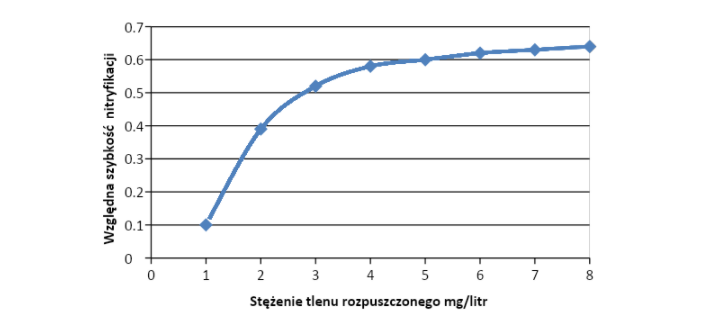
If the oxygen concentration is not high enough, denitrification and nitrate respiration occur, leading to the formation of nitrites (NO2–) from nitrate ions (NO3–)[7]. The graph of the dependence of the relative denitrification rate on the dissolved oxygen concentration is illustrated in the graph[6]:
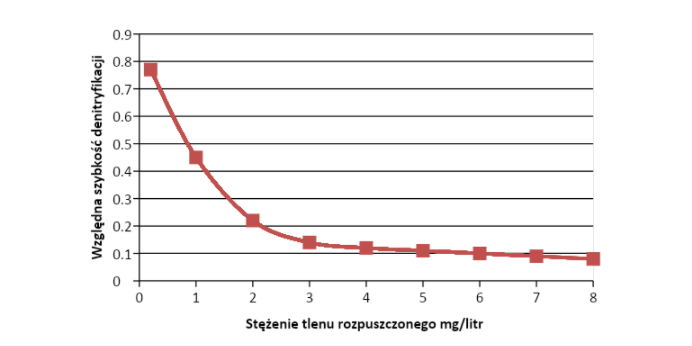
Generally speaking, denitrification is a beneficial phenomenon, leading to self-purification of water bodies. The situation is different in planted aquariums, where nitrogen consumption is relatively high. Denitrification is unfavorable because it causes nitrogen losses and contributes to disturbances in the Redfield coefficient[1].
[1] Own research 2016-2019.
[2] Gerhard Richter "Metabolic processes in plants" PWN 1975.
[3] Zurzycki J. Michniewicz M. "Plant Physiology" PWRiL 1979.
[4] Joanna Jeż-Walkowiak, PhD, Eng., Łukasz Weber, MSc, Eng. "Removal of ammonium ion from groundwater", 2008.
[5] Michael K.Stenstrom, Richard A.Poduska, "The effect of dissolved oxygen concentration on nitrification" Water Research Vol. 16 page 643-649. 1980.
[6] Sharil Niza B Abdul Aziz "Effect of dissolved oxygen concentration on nitrification and denitrification" 2005.
[7] Diana Walstad "Plants in the aquarium. Ecology of aquatic plants" Oriol 2007.