
1. Introduction
Planted aquariums, as a unique form of underwater landscape, consistently delight us with their beauty. Maintaining the tank's health requires proper care and attention to ensure the plants thrive. One of the key elements of maintaining a healthy environment in a planted aquarium is proper fertilization. Several methods of fertilizing planted aquariums are currently known, but GEN (Growthive Excellent Nutrition) stands out for its comprehensive approach to plant physiology, bringing numerous benefits to the entire aquarium ecosystem.
2. Why do we fertilize plants in an aquarium?
Fertilizing a planted aquarium primarily involves ensuring plant health, which directly impacts its functioning. Aquarium plants, like terrestrial plants, require nutrients for proper growth and development. The water used for aquarium water changes does not always provide all the necessary nutrients. Nutrient imbalances can lead to stunted plant growth, chlorosis, or necrosis.
3. Current methods of fertilizing the aquarium.
PMDD Method: The primary goal is to provide essential nutrients while limiting phosphate levels. This method is especially recommended for aquariums that don't utilize supplemental carbon dioxide (CO2 ) . Briefly, it involves dosing everything in excess, excluding phosphates, the lack of which reduces CO2 demand .
The EI (Estimative Index) method: The EI (Estimative Index) method represents a more flexible approach to fertilizing aquarium plants, eliminating the need for "precise" monitoring of individual nutrient levels. The fundamental element of this method is a constant and stable carbon dioxide (CO2) level . Briefly , it involves dosing everything in excess, including phosphates, while maintaining a constant and stable CO2 level .
4. Experience in using both methods.
Over the course of several years, we used both methods in our aquariums, trying to achieve beautiful and healthy plants. Fertilization was modified over time to include various substances that provided the plants with building blocks. Our observations revealed that, over time, the plants always exhibited some difficulty growing. The aquariums were stable, with no significant signs of algae, but the plants exhibited behavior that clearly indicated they were struggling. The most common signs included chlorosis of young leaves, necrosis of older leaves (holes in the leaves), leaf rot (in plants growing in dense clusters), and stem fragmentation, which began from the very bottom to the top. Despite these problems, the aquariums generally looked good. During maintenance, standard maintenance involved cutting back the plants, slicing off the lower sections, and replanting the most attractive tops. However, the results still fell short of expectations. Water tests showed parameters within the following ranges:
NO3– – 5-15mg/l
PO43- – 0- 1.5mg/l (depending on the method)
K+ – 10-25mg/l
Ca2+ – 20-40mg/l
Mg2+ – 5-10mg/l
Fe2+/3+ – 0.05-0.5mg/l
CO2– stable high level + high water circulation
Water changes – 50% once a week
Theoretically, everything was available to the plants in abundance; the assumptions of the EI method were met 100%. In the case of the PMDD method, we limited phosphates. The aquariums experienced periods of improved plant health; the flora during these periods displayed beautiful colors, healthy leaves, and thick stems. After a short period, the plants began to cause increasing problems despite constant doses of fertilizer. After a period of good growth, condition deteriorated. The plants were then uprooted, the substrate was cleaned, replanted, and the cycle continued, a vicious circle. Our observation is also confirmed by the author of the YouTube channel: Akwarystyka Roslinna Przemek p (I love ppm) in one of his videos available at the link: https://www.youtube.com/watch?v=l1vSO6jP398. The author of the channel states (3:45-4:13) "...I've said this many times that I've been using high-tech tanks for as long as I've had them, i.e. for 20 years. Believe me, I once had a problem-free aquarium for 3-4 months in 20 years... it's not just one thing, it was generally the longest, 3-4 months, up to 5 at most, and then problems always arise." We wondered why plants are able to maintain ideal condition for a certain period of the cycle, and what can be done to maintain this condition throughout the life of the tank? Years of analysis led us to conclusions that culminated in the Yokuchi Gen and the GEN (Growthive Excellent Nutrition) method itself.
5. Where is the error?
Looking at the parameters we maintain in our tanks, most people would think the proportions between these components are textbook. Generally available knowledge indicates that calcium and magnesium should be in a ratio of 4:1–5:1, nitrates to phosphates in a 10:1 ratio, potassium ideally in the range of 10–20 mg/l, but ideally somewhere between calcium and magnesium. Iron levels should be dependent on phosphate levels, manganese should be 3:1 with iron, and so on. So why, then, can't plants maintain very good long-term health even if we maintain ideal water parameters (according to generally available knowledge)?
Three key issues:
- A) Nitrogen to potassium ratio (N:K),
- B) Incorrect determination of potassium level using aquarium tests,
- C) Dosing inappropriate substances.
A) Nitrogen to potassium ratio (N:K)
The key aspect of the GEN (Growthive Excellent Nutrition) method is the ratio of the two main macroelements : nitrogen and potassium. It's important to emphasize nitrogen, not nitrate (NO3 ) . Aquarium tests determine nitrogen in the form of nitrates, while potassium tests determine the pure element. So how do we convert nitrates to nitrogen? Simply divide the nitrate level by 4.43. For example, if the aquarium nitrate level is 10mg/l (ppm), the pure nitrogen level is 2.27mg/l; if nitrates are 20mg/l, the nitrogen level is 4.54mg/l.
Comparing the concentrations of elements in a plant aquarium, generally accepted as the norm, the concentration of nitrates 20mg/l and potassium 15mg/l, we see that the ratio of nitrogen to potassium is N 4.54 mg/l to K 15mg/l, which is a proportion of more than 1:3 in favor of potassium.
B) Incorrect determination of potassium level using aquarium tests
Do aquarium test kits accurately indicate potassium levels in the aquarium? It's an extremely important question: can aquarists trust the results of these tests? Virtually all potassium tests available on the market are based on the turbidimetric (phenylborate) method, which involves the precipitation of potassium triphenylborate from a solution, resulting in a hazy sample. The user then determines how much solution is needed to make the point marked on the scale invisible at the bottom of the test tube. The reading itself is influenced by factors such as room lighting, the precision of dosing, and the fact that each person will notice the disappearance of the marker at different times.
The measurement method (phenylborate method) also has one, or rather two, major drawbacks. First, it is practically impossible to accurately determine low potassium levels in the tested sample. Levels of 0-5 mg/l are generally impossible to accurately determine. Second, the method also reacts with ammonium ions, so if the aquarium is newly filled and the nitrogen cycle is not functioning properly, ammonium ions will affect the measurement result.
We performed a series of tests using standard aquarium potassium test kits, determining the potassium level visually, photometrically, and with a flame photometer. The standard solution contained a potassium concentration of 4 mg/l. The first test was performed in which we visually determined the potassium level to be below 1 mg/l – the sample was very slightly hazy, making it difficult to determine the level. The next test was performed with a photometer. The test method is exactly the same as the previous test, but this time, the device will determine the ion concentration. The photometer showed a reading of <2 mg/l. Finally, we tested the level with a flame photometer, which indicated a measurement of 3.9 mg/l (a difference within the measurement error for small samples)
As we can see, determining the potassium level in an aquarium is very difficult, especially for low concentrations, and as we will show later in the article, low concentrations are the most important in the context of a properly functioning planted aquarium in the long term.
C) Dosing inappropriate substances.
To increase the concentration of a given element, aquarists typically perform a test and then dose the missing element to the desired amount. While this approach is certainly justified, the problem may lie in the preparations or substances the user is adding to the aquarium. The EI method has effectively popularized the dosing of dry salts or solutions based on them. Salt-based fertilizers are most commonly used to increase the concentrations of the main macronutrients: KNO3 (nitrogen source), KH2PO4 ( phosphorus source ) , and K2SO4 ( potassium source ) . While there is no doubt that K2SO4 is indeed a source of potassium (it contains almost 45% potassium), can KNO3 and KH2PO4 be considered good sources of nitrogen and phosphorus? After analyzing the matter, it turns out that KNO3 contains 13.7 % nitrogen , but a whopping 38.7% potassium . The situation is similar with KH 2 PO 4 salt, which, of course, contains 22.8% phosphorus and 28.7% potassium . As we can see, potassium is also the dominant component in these substances.
6. What should the nitrogen and potassium levels be in a plant aquarium?
First, we need to analyze how much of a given nutrient is present in the dry plant mass. Based on this, we will be able to determine which nutrient the plant requires in greater quantities. So, let's analyze the table:
- Nitrogen (N): approximate value: 1-6%
- Phosphorus (P): approximate value: 0.1-1.5%
- Potassium (K): approximate value: 0.5-4.0%
- Iron (Fe): approximate value: 0.002-0.1%
- Manganese (Mn): approximate value: 0.005-0.1%
- Zinc (Zn): approximate value: 0.001-0.05%
- Copper (Cu): approximate value: 0.001-0.01%
- Molybdenum (Mo): approximate value: 0.0001-0.01%
- Boron (B): approximate value: 0.002-0.1%
and some examples:
| Plant | Element | Contents [%] |
|---|---|---|
| Wheat (Triticum aestivum) | C (carbon) | 40–50 |
| N (nitrogen) | 2–4 | |
| K (potassium) | 1–2 | |
| Corn (Zea mays) | C (carbon) | 40–50 |
| N (nitrogen) | 1,5–3 | |
| K (potassium) | 1–2 | |
| Soybean (Glycine max) | C (carbon) | 40–50 |
| N (nitrogen) | 3–6 | |
| K (potassium) | 1,5–3 | |
| Potatoes (Solanum tuberosum) | C (carbon) | 40–50 |
| N (nitrogen) | 2–3 | |
| K (potassium) | 2–3 | |
| Sugar beet (Beta vulgaris subsp. vulgaris convar. crassa provar.) | C (carbon) | 40–45 |
| N (nitrogen) | 2–4 | |
| K (potassium) | 0,8–1,5 |
The list concerns cultivated plants, which have been much more thoroughly researched than other plant groups, but we managed to find some data on aquatic plants:
| Plant | Element | Contents [%] |
|---|---|---|
| Canada waterweed (Elodea canadensis) | C (carbon) | 42–47 |
| N (nitrogen) | 1–3 | |
| Potamogeton spp | C (carbon) | 40–45 |
| N (nitrogen) | 2–3 | |
| Marsh horsetail (Equisetum fluviatile) | C (carbon) | 42–46 |
| N (nitrogen) | 2–4 | |
| Sagittaria spp | C (carbon) | 40–45 |
| N (nitrogen) | 1–3 | |
| Floating pondweed (Potamogeton natans) | C (carbon) | 40–45 |
| N (nitrogen) | 1–3 |
Unfortunately, no data on potassium content was provided, but the similarity in the structure of carbon content to nitrogen of crop plants in relation to aquatic plants suggests that the potassium content will most likely be proportional.
After analyzing the data, we can clearly conclude that the main building block of plants (besides carbon, hydrogen, and oxygen) is nitrogen. In almost every case, the nitrogen level in the dry plant mass is higher than potassium. So, let's apply the analysis of the dry plant mass components to aquarium conditions, assuming we have 100g of dry plant mass in the tank, and the plants contain 4% nitrogen and 2% potassium in their dry mass. The nitrogen content will be 4g and potassium 2g, so to build 100g of dry mass, the plant will need 4000mg of nitrogen and 2000mg of potassium. Next, let's assume for our model that there are 100 liters of water in the aquarium, so for the plant to build 100g of dry mass, each liter of water must contain 40mg of nitrogen and 20mg of potassium.
Our water parameters are as follows:
andnitrogen (N) – 40mg/l
potassium (K) – 20mg/ l
Please remember the conversion factor we mentioned earlier, in order to accurately transfer the parameters to aquarium "conditions", you need to convert nitrogen to nitrates, so we multiply nitrogen by 4.43 - the water parameters look like this:
andzotanate (NO3–) – 177.2 mg/l
potassium (K+) – 20mg/l
As we can see, for every 1mg of potassium, there are almost 9mg of nitrates (NO3).The conclusions are simple: most aquariums suffer from chronic nitrogen deficiency, caused by incorrect interpretation of potassium test results, dosing inappropriate solutions based on salts that introduce an excess supply of potassium, and interpreting nitrate levels as elemental nitrogen.
Aquariums supplemented with high-potassium formulas will often fall into a vicious cycle. Often, by increasing nitrogen, phosphorus levels actually increase potassium levels, thereby hindering nitrogen absorption. It's also important to remember that aquariums are closed systems, so there's no leaching of excess nutrients, as is the case with cultivated plants. Excessive potassium relative to nitrogen can result in numerous symptoms, including slower growth, stem fragmentation, and degradation, especially in older leaves, necrotic spots often resembling textbook symptoms of potassium deficiency, leaf chlorosis caused by a lack of trace element absorption, and smaller new leaves.
The correct balance of ingredients in an aquarium should therefore be within the following ranges:
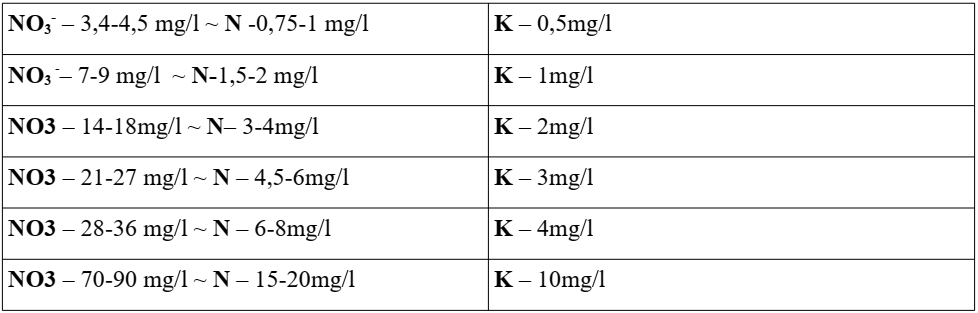
To better illustrate the relationships between individual macroelements, the following calculator was created based on dry plant mass research.
Calculator – GEN
Enter the NO3- value and then click “Calculate.” The remaining results will be automatically calculated.
Note: Use a period instead of a comma to enter values.
It is important to remember that the level of phosphates (PO43-) should be properly balanced with the level of nitrates (NO3–) determined by the Redfield coefficient for soil 10:1-1.5.
Years of observation show that the key factor isn't the specific concentration of elements, but the correct ratio between them. Specifically, the ratio between the two main macronutrients, nitrogen and potassium. If these elements are deficient but in the right proportion, plants will slow down their growth, reduce leaf size, and prevent excessive degradation. By maintaining the proper nitrogen and potassium ratio, we can also limit the supply of phosphorus, which will act as a "limiter" for the entire system, allowing us to maintain plants in excellent condition and moderate growth for a longer period of time. The GEN (Growthive Excellent Nutrition) method allows us to dose all the necessary nutrients in the right proportions, allowing us to precisely add the nutrient needed at a given time without excess ballast ions. GEN series fertilizers are balanced and designed so that when the same amount of each element is added, the relationships between the elements are maintained in the correct proportions. Begin fertilization by dosing the standard recommended dose of 1 click per 100 liters for 400 ml fertilizers and 1 drop per 5 liters for the GEN NANO series. For tanks with larger plant populations, it may be necessary to double or, in some cases, even triple the dose in very fast-metabolizing Dutch-style tanks.
You dose the pure ingredient - you need to increase nitrogen, you dose GEN N, phosphorus GEN P, potassium GEN K
GEN N – Contains several forms of nitrogen, the content of other elements is negligible, and additionally they have been balanced in relation to each other to maintain the appropriate proportions.
GEN P – Contains phosphorus and a small amount of magnesium
GEN K – Contains potassium in organic form, free of chlorides, sulphates and bicarbonates.
It's important to remember that micronutrients are absorbed when macronutrients are in the right ratios. Plant color cannot develop if the ratio between macronutrients is disturbed. Therefore, the first step is to ensure the proper balance of macronutrients.
GEN BG – Contains a complex of microelements necessary for the proper functioning of plants
GEN Fe – Contains a large dose of iron in two optimal forms and an additional dose of manganese, the elements are enriched with a hormone that stimulates plants to produce dyes.
7. GEN – The Key to Success in Fertilizing a Planted Aquarium
- Precise nutrient balance: GEN provides plants with everything they need, without excess or deficiency. This is crucial for their harmonious growth.
- Unique Nitrogen to Potassium Ratio: The GEN fertilization method is based on a nitrogen to potassium ratio of 1.4:1 – 2:1. This ratio in the GEN method has been experimentally determined to be optimal for planted aquariums. The proper balance between nitrogen and potassium stimulates the development of leaves, roots, and shoots, positively impacting the functioning of the entire tank.
- Minimized algae risk: Improving plant health translates into overall aquarium health. The GEN method minimizes the risk of algae problems by maintaining optimal conditions for plants, which are natural competitors for these undesirable organisms (alleopathy).
- Support for the ecosystem: Aquarium plants not only add charm, but also play an important role in the aquarium ecosystem; healthy plants oxygenate the substrate through their roots, thanks to which rhizosphere microorganisms help maintain stable conditions.
- No Restarts Required: Thanks to the GEN , we eliminate the oversupply of unwanted ballast elements and are able to precisely dose each element. This perfect balance translates into excellent long-term plant health, eliminating the need to restart the aquarium.
Introducing the GEN to your planted aquarium is the right approach to fertilizing aquatic plants, one that doesn't conflict with their physiology or the environment they inhabit. This method also takes into account and compensates for the specific properties of active substrates. It's also suitable for aquaculture on other substrates, such as gravel and sand. It's a sound investment in plant health, tank aesthetics, and overall environmental harmony. Thanks to the precise nutrient balance, plants grow beautifully, creating a spectacular underwater landscape.
– Otis F. Daniel G. Curtis Clark "Introduction to Plant Physiology" PWRiL 1958,
– Anna Nowotna-Mieczyńska "Physiology of mineral nutrition of plants." PWRiL 1965,
– Franck B. Salibury, Cleon Ross "Plant Physiology" PWRiL 1975,
– Gerhard Richter "Metabolic processes in plants" PWN 1975,
– Zurzycki J. Michniewicz M. "Plant Physiology" PWRiL 1979,
– Lityński T., Jurkowska H "Soil fertility and plant nutrition" PWN 1982,
– K. Mengel, EA Kirkby "Basics of plant nutrition" PWRiL 1983,
– VD Fageria (2001) Nutrient Interactions In Crop Plants, Journal Of Plant Nutrition, 24:8, 1269-1290,
-Kielland, K.,. "Landscape patterns of free amino acids in arctic tundra soils. Biogeochemistry, 31, pp.85–98. 1995,
-David A. Lipson, Steven K. Schmidt, Russell K. Monson, “Links between microbial population dynamics and nitrogen availability in an alpine ecosystem” EcologyVolume 80, Issue 5 1999,
– Diana Walstad "Plants in the aquarium. Ecology of aquatic plants" Oriol 2007,
– Bartosz Adamczyk, Mirosław Godlewski "Diversity of nitrogen acquisition strategies by plants." Kosmos Volume 59 Number 1-2 2010,
– Own research 2018 – 2024.
I've been running my aquarium with Yokuchi products for a year now. I use Ganban with JIBAN SOIL, ISHIKO mineralizer, SHŌKA bacteria, GEN BG, K, and N fertilizers, and I don't use any phosphorus at all. This is my first aquarium, and it runs smoothly.
I do weekly 50% RO water changes.
I'll be changing the setup within a month; the only thing I won't change is your products. Good luck with growing your company and perfecting your great products. P.S. You might want to consider an additional version of the powder substrate with a smaller granulation of 1-3mm (an alternative for smaller tanks). Cheers 😉
Thank you very much. Best regards
How do such low potassium values in relation to nitrogen relate to magnesium? It is known that potassium must be higher than magnesium, and the magnesium value at GH 6 is usually 10 ppm.
“The Colorful Island” – Island Style Aquascape Cinematic Update – YouTube Video
At the time of filming, the water parameters were around GH -8 (Mg ~11 mg/l and Ca ~40). At that time, potassium was undetectable with an aquarium test kit, although the actual level was probably around 2 mg/l. We haven't found any information in the literature about the need to set osmotic elements in this ratio. Our observations also don't support the need to follow such a rule.
And why do you assume it has to be higher, if you familiarize yourself with why this is the case with the nature of plants, you will find out that it is not necessarily so.
How did you determine that to obtain pure nitrogen, we divide nitrates by 4.46? Where does this formula come from? Do we also use a formula to calculate the amount of pure phosphorus? Regards
Thank you for your question. Please present the conversions where the coefficient for Nitrates and Nitrogen and Phosphates and Phosphorus comes from:
Calculation of the N to NO3- coefficient
Molar mass of N = 14g*mol-1
Molar mass of O = 16 g*mol-1
Molar mass of the nitrate anion (V) NO3- = 14+16*3 = 14+48 = 62 g*mol-1
Calculation of the NO3-/N coefficient = 62g*mol-1/ 14g*mol-1 = 4.428 (~4.43)
Calculation of the P to PO43- ratio
Molar mass of P = 31 g * mol-1
Molar mass of O = 16 g * mol-1
Molar mass of phosphate anion (V) PO43– = 31 + 16 * 4 = 31 + 64 = 95 g * mol-1
Calculation of the PO43-/P ratio = 95 g * mol-1 / 31 g * mol-1 = 3,064 (~ 3,06)
I'm maintaining an aquarium using the GEN method, using your products and following your advice. I have a question about the K content in my aquarium.
95% of the aquarium water comes from a reverse osmosis filter. The water has been mineralized to a low total hardness of around 4 mg/l. Gen K has not been added to the water. I don't understand why my potassium values are around 4 mg/l
(Zoolek test). I understand they come from Ishiko Plant Mineral mineralization. In this situation, if I were to additionally dose Gen K, the value would be significantly higher. Is this correct? I should also add that the Ca value is 25 mg/l and the Mg value is as high as 15 mg/l. Best regards, Piotr.
Thank you for your question. Please describe your aquarium in detail. Sometimes potassium leaches, for example, from the substrate or filter media.
Half of the substrate is natural 0.8-1.2 mm gravel/quartz sand and the other half is Jiban soil active substrate on Ganban substrate. In addition to roots, almond leaves, and a moderate amount of plants (epiphytes and stem plants), there are a few volcanic lava rocks in the aquarium. Two Aquael Ultra Filter 1400 filters contain Bioceramax 1200 ceramic inserts (4 chambers in total), foam (2 chambers in total), bioballs (2 chambers in total) plus two layers of Sera cotton wool. Link to the illustrative photo – https://drive.google.com/drive/folders/1xy41HwlD0yc_pW2VNykaJGDVdlxk6k5Z?usp=drive_link Other parameters PH - 7.3, NO3 - 10 mg/l, PO4 - 0.75 mg/l.
Thank you for your reply. Some potassium will likely leach from the substrate, especially since Jiban + Ganban was used, which contains a complete set of macro and micronutrients. Some could come from volcanic lava (some types of lava contain significant amounts of this nutrient). Some could also come from the ceramic filter media. However, analyzing the photo, you can see that your aquarium has very few plants, but two very powerful lamps operate above it. This, coupled with the pH, begs the question: Is carbon dioxide being dosed in the aquarium? Is the water you're using from an osmotic filter or an ion exchanger?
I'm dosing carbon dioxide, and the water comes from a reverse osmosis filter (7 pH). The plants are indeed few. I'll plant Cryptocoryne parva at the bottom to reduce phosphorus absorption. Fertilizing such an aquarium is definitely more difficult, but I want to be ambitious 😉 The hyperspot lamps only operate at 40% intensity. I think the gravel is the main culprit for such a high pH. Thanks again for your support. Best regards.
Hello. If I want to increase the PO4 value in my 100l aquarium by, say, 1, what dose of your phosphorus is needed (clicks). The same question applies to other fertilizers. Thank you and best regards.
The calculator will be available on our website soon ;-)
Hello. I have a small aquarium (60x45x36cm). I have Chihiros WRGB 60 Pro lighting. Oase Biomaster 600 filtration with matrix inside. I purchased the entire line of your 400ml Gen fertilizers, Shoka Bacteria, Ganban Power Base, and Jiban Soil. The water is RO with an Ishiko Plant Mineral mineralizer at GH 8. Co2 30mg/l. The aquarium is Iwagumi Grey Mountain Stone, which definitely increases water hardness. The plants are 90% Eleocharis. I would like to ask for a fertilizer dosage recommendation. The aquarium was started on March 24, 2025.
Best regards.
To begin with, I recommend reducing the lamp power by about 30% and dosing CO2 only when the lights are on. It's also crucial to maintain frequent, fairly large water changes, especially in the first two weeks. We recommend starting fertilization with basic doses of GEN K and slightly increasing GEN N, as Eleocharis plants are very nitrogen-loving. Once new, healthy growth begins to appear, you can begin dosing GEN BG at half the dose and gradually increase it. If the tank is stable and plant growth slows, you can add GEN P to complete the fertilization.
Thank you for your reply. How should I proceed with the carbohydrate and iron? Should I measure fertilizers in ml or clicks? I have larger bottles. Should I test the water with tests, or is it not necessary?
GEN C can be introduced at a basic dose once the plants have established roots and begun growing, and the biological flora has developed somewhat, ideally in week 3. We recommend introducing GEN FE when the tank is very densely planted and stable to improve plant color. However, remember that iron will be absorbed well if nitrogen and potassium are properly balanced, as discussed in the article.
Hello. By mineralizing reverse osmosis water with an Ishiko mineralizer, say to 5GH, we also mineralize the water to 0.7 KH. The label states that Ishiko also contains potassium. So I suspect it contains potassium carbonate or bicarbonate. So 0.7 KH is about 10 ppm of potassium. Is this relevant for dosing GEN K fertilizer? As I use tap water, I don't know how much potassium is present.
Yes, it's true that Ishiko plant mineral contains potassium, but not in the high dose you're describing. A calculator for preparing RO water will soon be available, which will help you precisely determine all the parameters of the water used for water changes.
Hello, is your calculator available yet? I have a question. I'm planning to switch to your fertilizer line, but I'd like my dosing pump to deliver your products, as I have one. Returning to the question: how many ml per click? For example, if my NO3 is 10, and I want to raise it to 15, how many clicks/ml are needed to raise it to the desired value? I have so many questions that I probably wouldn't fit the characters here
It's already available: https://yokuchi.com/gen/
The calculator allows you to change the number of clicks per ml and adjust the dose of each preparation accordingly. Calculations can be printed by exporting the file to PDF; the calculators offer many possibilities.
Hello and thank you very much for sharing the calculator—it's a really great decision on your part. I have a technical question regarding potassium and nitrate levels. I use RO water with Ishihiko Plant to mineralize my water at 4 GH. With this hardness, I'd like to know what the potassium and nitrate concentration should be. 4 GH gives about 6 mg of I21 Ca. Should I change the water and mineralize it with Ishiko Plant at 4 GH and then immediately mineralize the water with potassium and nitrates to my desired levels? Or should I use only Ishiko Plant and then add potassium and nitrates daily? Thank you in advance for your answer.
Of course, if there are plants in the tank, and I assume that's the case, then the water we supply should be supplemented with a certain amount of nutrients in the form of macronutrients. The Ishiko plant mineral calculator offers just such options. We can add nitrogen, phosphorus, and potassium directly, or mix it with tap water if we know its parameters. Click "Calculate" on the calculator to see the ratios at the bottom, where we can see the ratio of nitrogen to potassium. I emphasize nitrogen to potassium, not nitrate (NO3) to potassium. We recommend adjusting the water for water changes so that this ratio is around 1.3-1.6 (the article describes a slightly higher ratio of 1.4-2). The most important thing is that the nitrogen content exceeds the potassium content, e.g., 1.3-1.6mg/l of nitrogen to 1mg/l of potassium, or, to convert to nitrates, 5.75-7.1mg/l of NO3 to 1mg/l of potassium.
I'd like to ask one more question, if I may. I'm preparing my RO system for water changes using Ishiko Plant Mineral. I do this in 5-liter tanks, mineralizing at a GH of 4. Besides Ishiko Plant Mineral, should I add anything else to the water? For example, nitrogen fertilizer (if so, how much), and potassium fertilizer (if so, how much?) I have a very densely planted aquarium, I fertilize with CO2 from a bottle, and I have a Chichiros WRGB 2 Slim lamp set at 60 percent power.
To prepare water for water changes, we have created a very simple calculator: https://yokuchi.com/gen/
The calculator allows you to prepare RO water in any quantity, it is possible to mix RO water with tap water, it is possible to add micronutrients using GEN BG and it is possible to set the appropriate values of macronutrients using GEN N, GEN P, GEN K.
There are also videos below the calculators showing how to use them.
Thank you, Adrian, for your reply, but that's not what I meant. My question was related to something else. Should I use NPG and BG fertilizers in addition to the mineralizer, adding weekly concentrations to the RO water. For example, if I have fertilization set to 8 ppm NO3 per week, should I mineralize the water being changed and the RO water to 8 ppm NO3 and then fertilize daily with the same daily doses? Or should I use only Ishiko Plant in the RO water being changed and then apply the daily doses daily.
Thanks in advance for your answer.
It all depends on the metabolism of the tank, its type, and its technical parameters. For example, if the aquarium is a densely planted Dutch aquarium with high-intensity lighting, I would definitely recommend changing the water with one that immediately contains macronutrients in the correct proportions. Tanks with fewer plants and moderate lighting can do without adding macronutrients, as they can accumulate, resulting in a higher concentration of a given element at the end of the week than after the change. Therefore, the answer is: it depends; every aquarium is different. We recommend using GEN BG trace elements regardless of the aquarium type, as indicated on the product label. In the ISHIKO calculator, after selecting GEN BG, the calculator automatically adjusts the dose according to the label recommendation and the entered aquarium capacity.
Great, thank you very much, that's what I meant 🙂
I'd like to switch to your fertilizer line, but I honestly have some concerns about the amount of NO3 in my aquarium. Until now, my aquarium has been around 5-10 mg/l, with potassium at 15 ml/l. I now have more potassium thanks to the Sachem mineralizer, but that's not the point. Aquarium studies indicate that the NO3 concentrations you recommend are toxic to fish. Currently, it appears that for every 20 mg of potassium, I should have over 100 mg of NO3. Unless I'm misinterpreting something?
The study illustrates how much nitrogen a plant needs relative to potassium, based on the plant's dry weight. To use lower nitrate concentrations, simply lower the potassium concentration in the water.
The problem lies in the sources of N in our fertilizers. Using popular salts additionally introduces K or P, disrupting the intended proportions. Of course, there are N salts that don't contain as many additional elements, but this poses a serious risk. Urea and ammonium nitrate contain almost exclusively N, but the ammonium and amide forms can quickly generate algae problems. A mature biofilter bed appropriate to the tank size may be the solution. So what are the different N forms in the GEN N fertilizer?
The composition of the preparation is a company secret.
Hello, I'm just switching to your fertilizer line and have a question about Gen X. Can I switch to this fertilizer if the No3 is around 5-10 ppm after a water change, or is it better to use separate fertilizers, omitting the N. I'm open to any suggestions. Regarding the tank, it's somewhere between low-tech and high-tech with CO2, a moderate number of plants, No3: 5-10 ppm, Po4: 0 ppm, K: 0 ppm. Po4 and K are raised with QD fertilizers at a 10:1:20 ratio. For the past four weeks, I've been mineralizing the water with your product plus the recommended micro-Gen BG.
Gen X can be used as a base fertilizer supplemented with a separate ingredient if needed.
Good morning,
Will using your entire fertilizer line: GEN P, K, N, BG conflict with Tropica Aquarium Soil?
Best regards,
Arek
The most important thing will be to properly adjust fertilization to the plant's needs. Plant metabolism is stimulated by the intensity of lighting. Substrates from other manufacturers will have different absorption and resorption rates for certain nutrients, so patiently adjusting doses and observing the plants will be key.
Good morning. I'd like some advice on how to use your calculator. I have an 860-liter aquarium. I use RO water. The aquarium is 1.5 months old. I prepare the RO water in a 150-liter additional tank, treating it with Ishiko Plan Mineral and BG according to the instructions. I also add fertilizers daily to the main tank. I'm not sure which calculator to use to properly adjust the fertilization. Should I use Ishiko Plant only for the new water, or regularly for the main tank as well? Any advice?
Good morning
, the ISHIKO PLANT MINERAL calculator is used to prepare water for water changes. The calculator allows for flexible configuration and adjustment of the appropriate parameters of the water being changed. The GEN calculator on the left is used to calculate the daily fertilizer doses used in the aquarium.
Good morning. I have another question. I apply GEN P, K, N, and BG fertilizers through a Chihiros automatic dispenser. When I need to refill the dispenser, do I need to clean (perhaps disinfect) the containers, or is it enough to just add more (assuming the remaining fertilizer tips in the dispenser containers are the correct color and consistency)?
Best regards,
Arek
The products are well-protected and if stored properly, nothing should happen. If everything in the containers is in order and nothing alarming is visible, you can refill the products without any additional steps.