
- Entry.

Nitrogen is a biogenic element fundamental to biological processes occurring in plant and animal cells. Along with carbon, oxygen, and hydrogen, it is considered a basic element found in the tissues of all living organisms. Nitrogen occurs in numerous organic compounds, both chain and cyclic. In plants, this element is a component of amino acids, peptides, and proteins. It is a component of chlorophyll, cytochrome, cytokinins, and B vitamins. It is also found in some secondary metabolites, such as alkaloids, betalains, mustard oils, and cyanogenic glycosides. Therefore, nitrogen deficiency is a factor that severely limits plant growth and development.
- The problem of nitrogen sources.
The atmosphere is the largest and most limitless source of nitrogen. A column of air containing 80,000 tons of nitrogen hovers over every hectare of land . However, only a relatively small number of organisms can utilize atmospheric nitrogen. The vast majority of plants, however, can only survive and thrive thanks to a mechanism that allows them to obtain nitrogen from other organisms, primarily from their decomposition products and, to a lesser extent, from atmospheric precipitation (nitrogen oxides produced by lightning discharge).
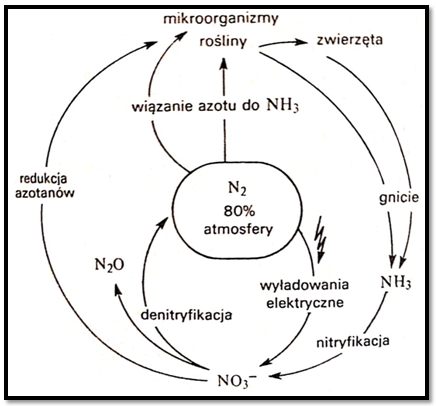
Diagram of the nitrogen cycle in nature.
3. Effects of nitrogen deficiency in the plant.
The most common symptoms of nitrogen deficiency, in addition to stunted leaf and root growth, include premature leaf drop of older leaves. Plants fail to produce lateral shoots. After pruning, plants fail to initiate growth cones, or their formation is significantly slowed. Leaves of plants growing in nitrogen-deficient conditions initially become light green and eventually turn yellow due to chlorosis. Plants defend themselves against nitrogen deficiency by effectively managing their available nitrogen reserves. Before leaf drop, plants resorb significant amounts of nitrogen into the young leaves and redirect it to the young leaf tissues.
4. Nitrogen acquisition strategies by plants.
As the above facts demonstrate, plants must absorb significant amounts of nitrogen for proper development. To this end, they have developed a wide range of strategies for obtaining this valuable element. In addition to nitrogen absorption in inorganic form (ammonium and nitrate ions), plants are capable of obtaining nitrogen from urea and amino acids. Additionally, plants can obtain nitrogen through symbiosis with mycorrhizal fungi or bacteria. Insectivorous plants have evolved a different nitrogen uptake strategy, creating traps for insects and, after capturing them, digesting them using enzymes secreted from glandular cells. This list of plant nitrogen acquisition strategies is complemented by the discovery of proteases secreted from roots. By digesting soil proteins, plants can increase the pool of amino acids—a source of nitrogen for plants.
5. Inorganic nitrogen sources.
It is widely believed that plants are capable of uptake of inorganic nitrogen in the form of ammonium (NH4+) and nitrate (NO3-) ions . Although ammonium ions are energetically preferable because they do not require reduction before incorporation into amino acids, nitrate is more available to plants. This is due to the retention of ammonium ions in the substrate sorption complex due to the positive charge of NH4 + . Nitrate ions, on the other hand, are not bound by the negatively charged soil complexes and therefore do not remain in the substrate. Furthermore, plants do not prefer ammonium ions, as high concentrations can negatively affect root and shoot growth. NH4+ uptake is associated with the release of protons into the substrate, which causes its acidification and a simultaneous decrease in cation uptake. Although there are interspecific differences in NO 3 - and NH 4 + uptake preferences , the presence of both inorganic nitrogen sources ensures proper plant growth. Nitrates require reduction before incorporation into amino acids. Nitrate reduction to ammonium occurs by the gradual addition of two electrons to nitrogen. The entire process occurs in four stages:
(NO3–) N5+ 2ē→ N3+ 2ē→N1+ 2ē→N1-2ē→N3- (NH4+)
To date, only two enzymes participating in this reaction pathway have been identified: nitrate reductase, which catalyzes the conversion of nitrate to nitrite (the first step), and nitrite reductase, which catalyzes the reduction of nitrite to ammonium. It is also hypothesized that it also catalyzes the remaining three steps. In both lower and higher plants, nitrate reductase occurs in the basal cytoplasm. The active complex of this enzyme, with a molecular weight of approximately 50,000, also includes NADH (nicotinamide adenine dinucleotide), FAD (adenine dinucleotide), Mo (molybdenum), and Fe (iron). The inducer of reductase synthesis is nitrate (the substrate). Furthermore, it has been shown that this enzyme undergoes a relatively intensive regeneration process.
The first stage of nitrate reduction can therefore be generally represented as follows:
NO3- NADH+H+, FAD, Mo6+,Fe2+→NO2-+H2O
Nitrite reduction in green plants takes place in chloroplasts via reduced ferredoxin, meaning that this process is closely linked to electron flow during photosynthesis. In cells lacking chlorophyll, this reaction takes place in the presence of NADPH (nicotinamide adenine dinucleotide phosphate), while in vitro, the electron donor may be, for example, reduced benzylviologen. Nitrite reduction can be generally represented by the equation:
NO2- ferredox reduced (NADPH)→ NH4+
The ammonium ion produced in the reactions described above is used to amminate specific keto acids. Therefore, the reduction described is called assimilatory nitrate reduction.
6. The ability of plants to absorb organic forms of nitrogen.
Already in the mid-20th century, it was observed that plants are capable of uptake of amino acids. In the last decade or so, much research has been devoted to the issue of amino acid uptake by plant roots. Amino acids can be taken up in relatively significant amounts both in the laboratory and in the field. The potential importance of organic nitrogen in the form of amino acids has been observed in numerous ecosystems, including tropical ecosystems, the Colorado steppes, northern coniferous forests, and agricultural ecosystems. Studies on wheat have shown that cultivated plants can also take up approximately 20% of the supplied glycine without prior mineralization. The fact that the amount of inorganic nitrogen in the soil of some ecosystems does not meet plant needs also supports the idea that plants must also take up organic nitrogen. Studies of plant and microorganism preferences for various amino acids have shown that plants take up glycine more efficiently than others, while microorganisms prefer amino acids with higher molar masses. Microorganisms' preference for amino acids other than glycine may stem from the fact that this amino acid is a poorer carbon source, which means they may "leave" glycine for plants. Research suggests that plants can take up more amino acids when their concentrations are high in the soil. It's also important to remember that soil is not homogeneous in terms of organic nitrogen concentration. There are areas with increased organic nitrogen, which results from animal death or root cell lysis. Furthermore, organic fertilizers also provide particularly high amounts of organic compounds. In areas rich in organic compounds, their concentration may exceed the microorganisms' demand for this nitrogen source, providing plants with increased access to these compounds. Another source of nitrogen for plants is urea, which undergoes hydrolysis in the soil catalyzed by urease secreted by microorganisms. Urea is converted to ammonium ions, which are then oxidized to nitrates through the nitrification process. Plants fertilized with urea gain access to urea, ammonium, and nitrate ions. Urea can be absorbed not only from the substrate but also through leaves. Plants can also absorb urea in its unchanged form, and only within the plant cells is it converted to ammonium by urease, which is then incorporated into amino acids and proteins.
7. Competition for inorganic nitrogen.
Inorganic nitrogen in soil comes from the mineralization of organic nitrogen compounds to NH4 + and subsequent nitrification to nitrate. Nitrate can also be formed from organic nitrogen compounds by the action of heterotrophic bacteria and fungi, thus bypassing ammonification. Mineralization and nitrification are believed to be key factors in the nitrogen cycle, and plants benefit from the excess inorganic nitrogen not taken up by microorganisms. This is supported by studies in which, 24 hours after application of labeled 15NH4+ and 15NO3- to the soil , most of the labeled nitrogen was detected in the microbial biomass. In short-term studies (24 hours), microorganisms took up five times more NH4 + and twice as much NO3- than plants . However, in long-term studies, plants acquired most of the labeled NH4 + . As in the case of competition for amino acids, the outcome of competition for inorganic nitrogen is potentially influenced by many factors, including the presence of mycorrhizal symbionts and root proliferation in areas particularly rich in inorganic nitrogen.
-Bartosz Adamczyk, Mirosław Godlewski "Diversity of nitrogen acquisition strategies by plants." Kosmos Volume 59 Number 1-2 2010.
-Gerhard Richter "Metabolic processes in plants" PWN 1975.
– Franck B. Salibury, Cleon Ross "Plant Physiology" PWRiL 1975.
-Zurzycki J. Michniewicz M. "Plant Physiology" PWRiL 1979.
-Otis F. Daniel G. Curtis Clark "Introduction to Plant Physiology" PWRiL 1958.
-Anna Nowotna-Mieczyńska "Physiology of mineral nutrition of plants. PWRiL 1965
-Diana Walstad "Plants in the aquarium. Ecology of aquatic plants" Oriol 2007
-Kielland, K.,. "Landscape patterns of free amino acids in arctic tundra soils. Biogeochemistry, 31, pp.85–98. 1995
-David A. Lipson,Steven K. Schmidt, Russell K. Monson, “Links between microbial population dynamics and nitrogen availability in an alpine ecosystem” EcologyVolume 80, Issue 5 1999